Stream: A Generalized Continual Learning Benchmark and Baseline
Iordanis Fostiropoulos Jiaye Zhu Laurent Itti
University of Southern California
Overview
In General Continual Learning (GCL), the goal is to learn a sequence of tasks that are presented once while maintaining performance on all previously learned tasks without the task identity during both the training and the evaluation phase. Stream provides a method to construct an infinite long sequence of tasks with varying degree of domain-gap (learning-gap) from a limited set of multi-modal dataset.
For Detailed instructions please see our [Code].
Intuition
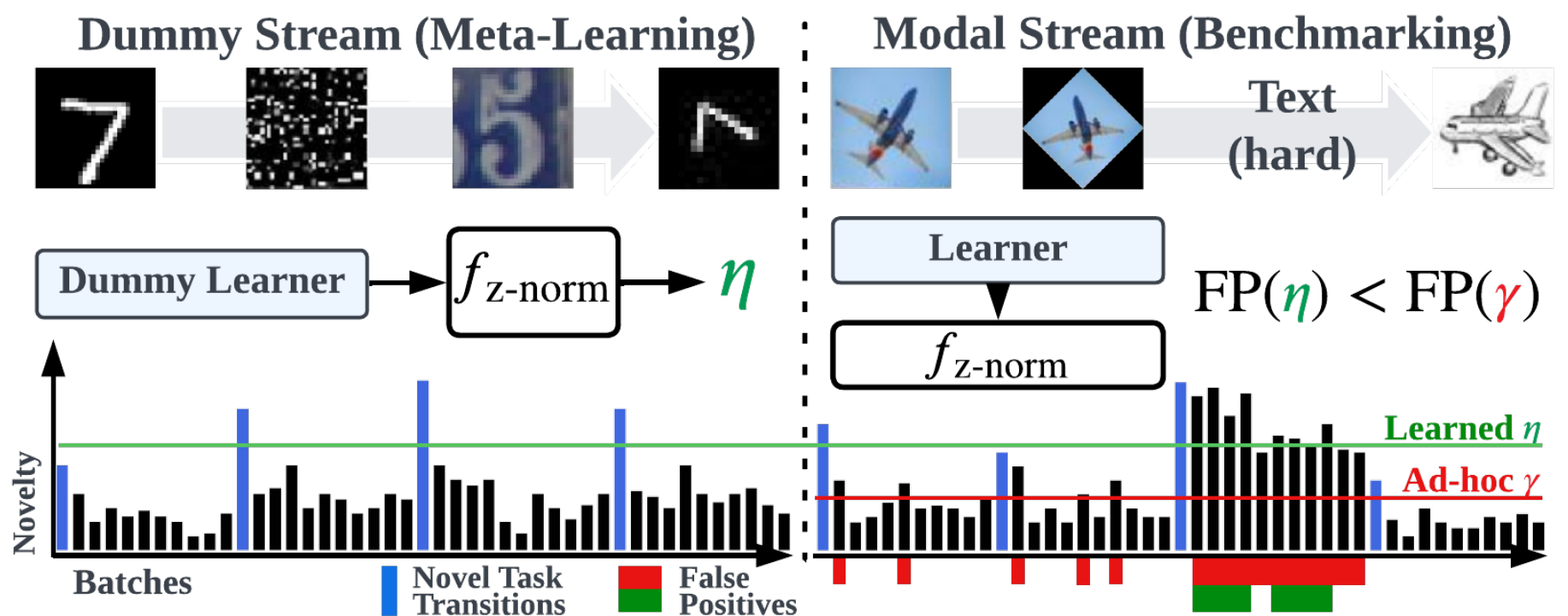
Illustration of our Stream benchmark and a threshold-based approach in identifying novelty. Left: our meta-learning process uses a dummy learner that does not attempt to mitigate
forgetting. It is exposed to a stream of heterogeneous tasks (with different learning-gaps), just
like the actual learner. By monitoring transitions to novel tasks (blue bars) over time, the dummy
learner, in its simplest form, just adjusts a dynamic novelty threshold η (green) to maximize future
novelty prediction. Right: compared to the previously used static ad-hoc threshold γ (red), our
meta-learning process improves the false positive rate (i.e. area under the novelty bars). Yet, using a
threshold can still fail for difficult tasks (e.g. Text) where difficult samples are hard to distinguish
from novelty.